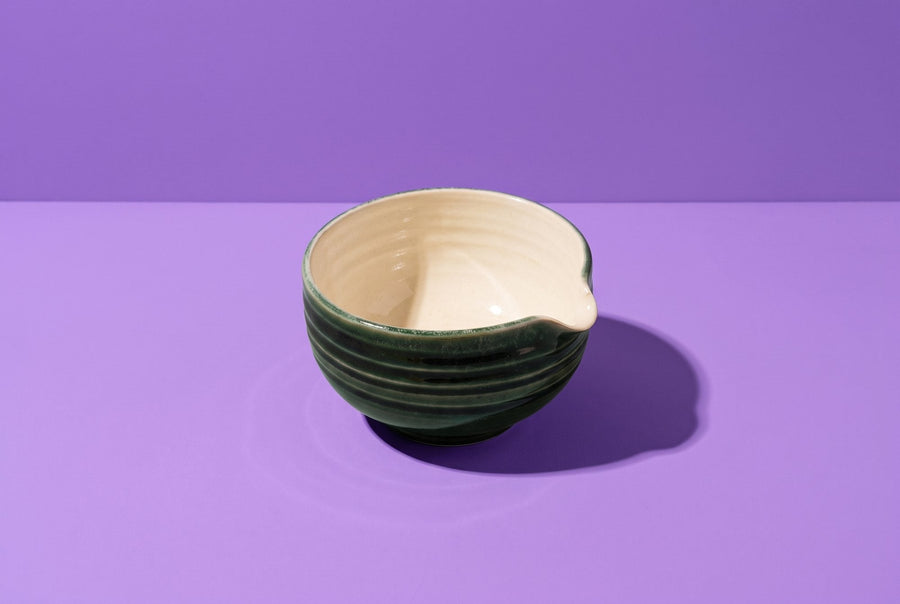
Where does matcha come from?
Powdered tea was invented in China, matcha was refined in Uji, and today Kagoshima grows the most tencha. The history, the growing regions with MAFF data, and what "Uji" on a label really means.

Powdered tea whisked with water was first drunk in China under the Song dynasty (960-1279), and the monk Eisai brought the custom to Japan in 1191. Today's matcha, made from leaves shaded before harvest, was developed in the 16th century in Uji near Kyoto. Yet the largest producer of tencha, the raw material for matcha, is now Kagoshima in southern Japan: in 2025 it produced 2,670 of 6,278 tonnes, or about 43%.
Key points
- Powdered tea was already whisked in bowls under the Song dynasty. Emperor Huizong (reigned 1100-1126) advised that bowls be deep and wide so the powder could be whisked properly.
- The monk Eisai (1141-1215) brought tea from China in 1191, and in 1211 he wrote the treatise Kissa yōjōki.
- According to MAFF, shade growing (ōishita) was developed in Uji in the 16th century for tea masters such as Sen no Rikyū.
- In 2023 tencha came mainly from Kagoshima 38%, Kyoto 23%, Shizuoka 12%, Aichi 9% and Mie 8% (MAFF).
- In 2024 Kagoshima overtook Shizuoka in total tea production for the first time: 27,000 t against 25,800 t.
- Self-propelled harvesters work 98.4% of fields in Kagoshima and 20.8% in Kyoto (MAFF, 2023).
- "Uji-cha" can come from four prefectures (Kyoto, Nara, Shiga, Mie) if it is processed by a Kyoto company within the prefecture.
Where was powdered tea born?
In China. Under the Song dynasty (960-1279) tea was ground into powder, topped with hot water in a bowl and whisked to a froth. Japan adopted this way of drinking tea from Chinese Buddhist monasteries and later developed it in its own way.
You can see traces of this culture in museums. The Cleveland Museum of Art shows a black jian tea bowl from Fujian province from the Southern Song period. In its description the museum quotes Emperor Huizong's advice: tea bowls should be deep and wide so the powder can be whisked well in them. It is the same logic you know from today's matchawan.
Song-era tea was not today's matcha, though. The leaves were not shaded the way they are now, and they were processed differently. The matcha you know is the result of several centuries of development in Japan.
Who brought matcha to Japan?
According to Japan's Ministry of Agriculture, Forestry and Fisheries (MAFF), the history of Uji tea begins in 1191, when the monk Eisai returned from China with tea. The monk Myōe planted it at Kōzan-ji temple in Toganoo near Kyoto, and some of the bushes were later moved to Uji.
Eisai (1141-1215) went on to found the Rinzai school of Zen in Japan. According to the Japanese government's database of tourism descriptions (Japan Tourism Agency), in 1211 he wrote the treatise Kissa yōjōki ("Drinking Tea for Health") and presented it to the shogun Minamoto no Sanetomo. In the Kamakura period (1185-1333) tea was treated mainly as a medicine. This is historical context, not medical knowledge: we cover current research on what matcha contains separately in the article matcha: composition and properties.
Sources differ on the date of matcha's "arrival". Historian Rebecca Corbett of the University of Southern California dates the introduction of matcha to Japan to around 1250. The difference comes down to what you call matcha: 1191 marks the arrival of tea and the habit of drinking it, while matcha as we understand it today still needed centuries of changes in cultivation.
How did Uji become the capital of matcha?
Through the patronage of those in power and one invention: shade growing. According to MAFF, in the 15th century the Ashikaga shoguns valued Uji tea, and tea gardens were established there with official support. In the 16th century, at the request of tea masters such as Sen no Rikyū, Uji developed the ōishita ("under cover") method, which produced a deep green matcha with strong umami and less bitterness.
The next stages went like this:
- Tea contests. According to the Japan Tourism Agency, from the late Kamakura period the elite held contests in which guests guessed which of 10, 20 or even 100 bowls held the "true tea" from Toganoo.
- Sen no Rikyū (1522-1591). In 1570 he first served tea to Oda Nobunaga and became his tea adviser, later serving Toyotomi Hideyoshi. He gave the tea ceremony its form based on the wabi-sabi aesthetic. More on this in the article matcha in Japanese culture.
- Tea for the shogun. In the Edo period the best Uji tea was carried to Edo for the shogun (Chatsubo dōchū, "the tea jar procession"). According to the Japan Tourism Agency, from 1652 some of the tea was stored until autumn at Katsuyama Castle in what is now the city of Tsuru, because summer in Edo was too hot.
- 1738. Nagatani Sōen developed a method of hand-rolling leaves in Uji, from which, according to MAFF, later Japanese tea production methods derive. Combining shading and rolling later gave rise to gyokuro.
Where is matcha grown in Japan today?
Most tencha now comes from Kagoshima, followed by Kyoto (the Uji region), Shizuoka and Aichi (Nishio). According to MAFF, in 2023 these four prefectures together produced 82% of the country's tencha. In 2025 Kagoshima alone produced more tencha than Kyoto, Shizuoka and Aichi combined.
| Region (prefecture) | Tencha 2025, t (share) | Tencha 2023, share (MAFF) | Known for |
|---|---|---|---|
| Kagoshima (Kyushu) | 2,670 (43%) | 38% | earliest harvests in Japan, flat fields, almost full mechanisation, a wide range of cultivars |
| Kyoto (Uji) | 989 (16%) | 23% | birthplace of shade growing, gyokuro and tencha (2nd in the country), hillside fields, little machinery |
| Shizuoka | 875 (14%) | 12% | largest growing area in Japan (13,300 ha in 2023), mainly sencha and fukamushi sencha |
| Aichi (Nishio, Toyota) | 463 (7%) | 9% | tencha grown mainly in Nishio and Toyota, with a large share of first harvest |
| Mie | 398 (6%) | 8% | 1st in Japan for gyokuro and kabusecha in 2023 |
| Miyazaki (Kyushu) | 304 (5%) | n/a | mainly sencha, 1st for pan-fired tea (kamairicha) |
| Fukuoka (Yame) | 280 (4%) | n/a | gyokuro (3rd in the country), protected designation "Yame Dentou Hongyokuro" |
| Nara (Yamato) | n/a | n/a | plantations on the Yamato plateau at 200-500 m, 2nd for kabusecha (11% in 2023) |
| Japan total | 6,278 | 4,176 t |
The 2025 figures come from the national federation of tea producers (全国茶生産団体連合会) and were published by Aichi Prefecture; we calculated the shares ourselves. The 2023 shares come from MAFF materials. These are two different data sets, so compare them with care. Nara does not appear among the leading tencha producers in either of them.
Kagoshima
A warm climate and the earliest harvests in the country. According to MAFF, the new tea season starts here at the end of March (hashiri-shincha), and according to the prefecture's development plan the first harvest runs from early April. Early, mid and late cultivars allow the harvest to be spread over time. We explain below why this region has grown so much.
Kyoto and Uji
The region with the longest matcha history and the strongest brand. In 2023 Kyoto was second in Japan for both gyokuro and tencha. Fields in and around Uji are often small and on slopes, which is why, according to MAFF, self-propelled harvesters work only 20.8% of the area here. In trials by the Kyoto Prefectural Tea Research Institute, the cultivars Samidori, Okumidori and Asahi produced the best tencha.
Shizuoka
The largest tea-growing area in Japan: 13,300 ha, or 37% of the national total in 2023. Shizuoka is known for sencha, especially fukamushi sencha (deep-steamed). It is producing more and more tencha: 875 t in 2025 according to the producers' federation, against 505 t in 2023 according to MAFF.
Aichi and Nishio
According to Aichi Prefecture, tencha here grows mainly in Nishio and Toyota, and it stands out for its high share of first harvest. Nishio even had a protected geographical indication, "Nishio no Matcha", but in February 2020, at the request of the producers' association itself, MAFF withdrew the registration. According to a USDA report, this was the first such withdrawal since Japan's GI system was created in 2015.
Fukuoka and Yame
Yame is associated above all with gyokuro. The designation "Yame Dentou Hongyokuro" (no. 5), registered by MAFF, describes cultivation under rice-straw mats, and says of the region that the surrounding mountains bring large temperature differences between morning and evening and morning mists. Fukuoka produces little tencha: 280 t in 2025.
Nara
Nara tea (Yamato-cha) grows mainly on the Yamato plateau at 200-500 m, in a cool climate with large day-night temperature differences (MAFF Kinki Regional Agricultural Administration Office, citing Nara Prefecture). Nara is known for kabusecha rather than tencha, but under the definition of Uji-cha, leaves from Nara can end up in tea sold under that name.
Why did Kagoshima become the largest tencha producer?
Because it has flat fields where machines do almost everything, the earliest harvests in the country and a wide range of cultivars. As demand for matcha grew, growers began switching from sencha to tencha. According to MAFF, Kagoshima's tea output is flat, with tencha replacing sencha.
- Mechanisation. According to MAFF, in 2023 self-propelled harvesters worked 98.4% of fields in Kagoshima, 83.6% in Shizuoka, 20.8% in Kyoto and 68.7% on average across Japan. The prefecture's 2019 development plan highlights the large share of flat fields and large farms.
- Early season. The earliest new tea in Japan starts here at the end of March.
- Range of cultivars. Across Japan about 70% of plantings are Yabukita, but in Kagoshima only about a third. The rest include Yutakamidori, Saemidori, Asatsuyu and Okumidori. According to research by the prefecture's agricultural centre, Okumidori gives matcha a particularly deep green colour.
- Rapid growth. Kagoshima's share of national tea production rose from 11.2% in 1982 to 32.6% in 2018. In 2024 the prefecture ranked first for the first time (27,000 t against 25,800 t in Shizuoka, MAFF data cited by Nagasaki Customs). Tencha grew even faster: in MAFF's figures Kagoshima had 578 t in 2018 and 1,585 t in 2023, and according to the producers' federation 2,670 t in 2025.
One thing is still difficult: covering the fields. According to MAFF it is one of the most labour-intensive stages and hard to mechanise, and the Kagoshima Prefecture plan lists it as a problem given the shortage of workers.
Matcha Premium and Matcha Unique from Mild come from Kagoshima: both are from the first spring harvest, made from shade-grown tencha leaves ground on stone mills. Unique is our top line, with pronounced umami, for drinking with water alone. You can check current availability in the matcha collection.
Does the region determine how matcha tastes?
Only partly. Taste also depends on the cultivar, the length and intensity of shading, harvest time, processing and freshness. Two matchas from one prefecture can differ more than matchas from two different prefectures. We have not found reliable research that assigns a fixed flavour profile to whole regions.
The data show this clearly. In long-term trials at the Kyoto tea research institute, on the same field and with the same shading, cultivars differed markedly in tencha quality. A study from Kagoshima Prefecture showed that the colour of matcha depends on chlorophyll content and leaf thickness, and so on the cultivar. The region tells you where the tea comes from, but harvest time and freshness tell you more about how it tastes. We describe how to judge this yourself in the article what is matcha.
How to read matcha's origin on the label
Look for the country, prefecture or region and the harvest. "Japan" alone is the minimum; "Kagoshima, first spring harvest" tells you much more. Keep in mind that some regional names have broader definitions than the name suggests.
| On the pack | What it means | What to watch for |
|---|---|---|
| Uji-cha / Uji matcha | according to the Kyoto Prefecture Tea Industry Council (京都府茶業会議所), as cited by MAFF: tea from Kyoto, Nara, Shiga or Mie prefectures, processed by a Kyoto company within the prefecture using the Uji method | the leaves do not have to come from Uji itself |
| Japanese Tea / 日本茶 (with GI logo) | a protected geographical indication since 10.07.2026: leaves from Japan, processed in Japan | the designation says nothing about quality or harvest |
| Product of Japan, no region | tea from Japan | no information on region or harvest |
| Prefecture name (Kagoshima, Shizuoka, Aichi) | growing region | check whether the harvest is also given |
| "Japanese style", "matcha" with no country | no way of knowing where the tea is from | outside Japan the word "matcha" is not legally protected |
Common mistakes when choosing matcha by origin
- Treating "Uji" as a guarantee. Why it is a mistake: Uji-cha can come from four prefectures, and the name says nothing about the harvest. How to fix it: also look for the harvest and the best-before date.
- Dismissing Kagoshima as "less traditional". Why: it is now Japan's largest tencha producer, with the country's earliest harvests. How to fix it: judge the specific matcha, not the region.
- Confusing "made in Japan" with "grown in Japan". Why: the country of packing and the country of growing are not always the same. How to fix it: look for information on the country of growing or the "Japanese Tea" designation with the GI logo.
- Looking for a region instead of a harvest. Why: according to MAFF, first-harvest tea cost more than twice as much wholesale in 2023 as second-harvest tea, and you can usually taste it. How to fix it: for drinking with water, choose the first spring harvest.
Frequently asked questions
Does matcha come from Japan or China?
Powdered tea whisked with water comes from China in the Song dynasty (960-1279). Matcha in its present form, made from shaded tencha, developed in Japan, and shade growing was developed in Uji in the 16th century.
Who brought tea to Japan?
According to MAFF, the history of Uji tea begins in 1191, when the monk Eisai returned from China with tea. In 1211 Eisai wrote the treatise Kissa yōjōki.
Where is the most matcha produced?
In Kagoshima Prefecture. According to MAFF it produced 38% of the country's tencha in 2023, and according to the producers' federation 2,670 of 6,278 t in 2025, or about 43%.
Is Uji matcha the best?
Uji has the longest history and excellent tencha cultivars, but the region does not guarantee quality. What matters is the harvest, cultivar, shading and freshness, and good matcha is also made in Kagoshima, Aichi and Shizuoka.
What is Uji-cha?
Tea from Kyoto, Nara, Shiga or Mie prefectures, processed by a Kyoto company in Kyoto Prefecture using a method that originates in Uji. That is how the Kyoto Prefecture Tea Industry Council (京都府茶業会議所) defines it, and MAFF's regional office cites the definition.
Why does Kagoshima produce so much tea?
It has flat fields, where harvesters worked 98.4% of the area in 2023, a warm climate with the earliest harvests in Japan and a wide range of cultivars. In 2024 it overtook Shizuoka in total tea production for the first time.
Does Nishio have a protected matcha name?
It did. "Nishio no Matcha" was registered as a geographical indication, but in February 2020 MAFF withdrew the registration at the request of the Nishio producers' association.
Is there an official designation for Japanese tea?
Yes. Since 10 July 2026 "日本茶 / Japanese Tea" has been a geographical indication registered by MAFF (no. 179). It covers tea made from leaves grown in Japan and processed in Japan.
Sources
- MAFF, Uji Tea (Traditional Foods in Japan)
- MAFF, Kagoshima Tea (Traditional Foods in Japan)
- MAFF, materials on the state of the tea industry: tencha by prefecture, mechanisation, prices (2023 data) and production by prefecture and tea type
- Aichi Prefecture, tea production in 2025 (tea producers' federation data)
- Nagasaki Customs, Kagoshima branch, green tea exports and production by prefecture, 2025
- Kagoshima Prefecture, "Kagoshima-cha" tea development plan, 2019
- MAFF Kinki Regional Office: teas of the Kinki region, definition of Uji-cha, Yamato-cha (2024)
- Japan Tourism Agency, Tea Ceremony and Ii Family Collection and Chatsubo Dochu
- Cleveland Museum of Art, jian tea bowl from the Southern Song dynasty
- Rebecca Corbett, The Conversation (republished by PBS NewsHour), 2025
- USDA FAS, Japan Withdraws Product from GI Protection List, 2020
- MAFF, GI register no. 179: 日本茶 and no. 5: Yame Dentou Hongyokuro
- Kyoto Prefectural Tea Research Institute, cultivars for tencha