How to make matcha step by step
Usucha and koicha ratios from tea houses in Kyoto and Uji, every step with an explanation of why you do it, hot and iced matcha latte, and a troubleshooting table: bitterness, lumps, no foam.

To make matcha, sift 1-2 g of powder into a bowl, pour in 60-80 ml of water at 70-80°C and whisk with a chasen in a quick M-shaped motion for 15-20 seconds until a fine foam forms. The Kyoto tea house Ippodo (in business since 1717, according to the company) gives very similar instructions: 2 g of matcha, 60 ml of water at 80°C and 15 seconds of brisk whisking.
Key points
- Usucha (thin, everyday): 1-2 g of matcha, 60-80 ml of water at 70-80°C, 15-20 s of quick whisking.
- Koicha (thick): according to Ippodo, 4 g of matcha to 30 ml of water at 80°C, kneaded slowly, no foam.
- Iced latte: 2 g of matcha whisked with 40 ml of water at 70-80°C, poured over 150-200 ml of milk with ice.
- Sifting is not a fad: Marukyu Koyamaen writes that sifted matcha disperses more easily in water.
- Motion: back and forth from the wrist, not in circles. Circles mix, but they do not aerate.
- Caffeine: 1 g of matcha contains 18.9-44.4 mg of caffeine, so a 2 g serving has about 38-89 mg.
- After opening: Ippodo recommends using matcha within about a month and keeping it tightly closed, away from light and odours.
Usucha or koicha: which matcha are you making?
Usucha is "thin tea": little powder, more water, whisked to a foam. Koicha is "thick tea": twice the powder in half the water, kneaded slowly into a smooth, pourable paste. If you are just starting out, you are making usucha. Koicha needs a very mild-tasting matcha, because at that concentration any bitterness comes through clearly.
Ratios vary a little between tea houses. They are worth seeing side by side, because they show there is no single "correct" number, only a sensible range:
| Source | Type | Matcha | Water | Temperature | Whisking |
|---|---|---|---|---|---|
| Ippodo (Kyoto) | usucha | 2 g | 60 ml | 80°C | briskly, 15 s |
| Ippodo (Kyoto) | koicha | 4 g | 30 ml | 80°C | slowly, 15 s |
| Marukyu Koyamaen (Uji) | usucha | approx. 1.5 g | 70 ml | 70-80°C in summer, 75-85°C in winter | briskly back and forth, to a fine foam |
| mild | usucha | 1-2 g | 60-80 ml | 70-80°C | M motion, 15-20 s |
Marukyu Koyamaen says plainly that these are guidelines and that you adjust the amount of powder, water and temperature to your own taste. A good starting point: 2 g to 70 ml. Too strong? Add 10 ml of water. Too flat? Add half a gram of powder next time.
What you need and what to use instead
The minimum is matcha, water at the right temperature, a vessel and something to break up the powder. A sieve and kitchen scales are not essential, but they do the most for consistency. The rest of the equipment has substitutes that work worse or differently, but they work.
| Equipment | What it is for | Substitute | What you lose |
|---|---|---|---|
| Chasen (bamboo whisk) | breaks up the powder and aerates the tea | electric frother, screw-top jar, shaker | the foam is usually thinner and less stable |
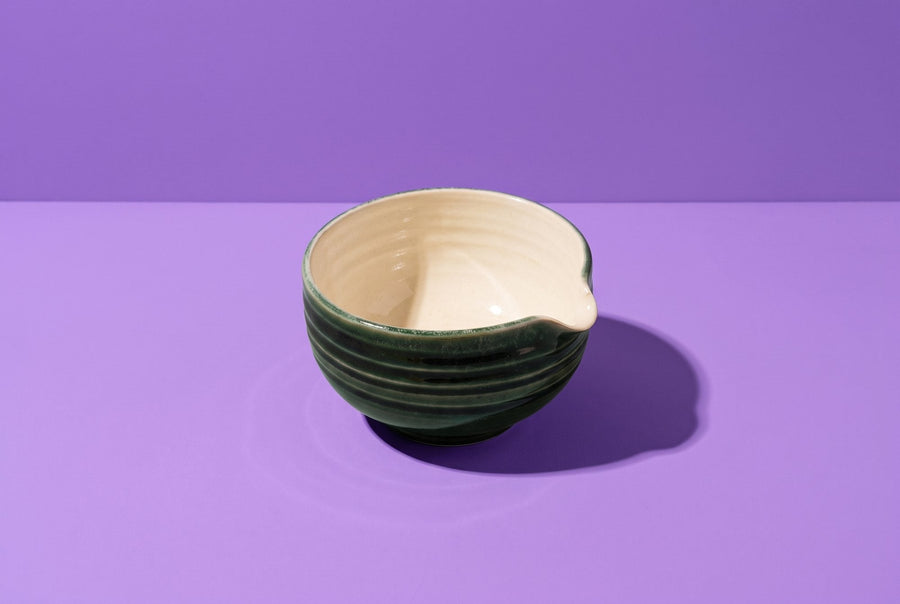
| Chawan (wide bowl) | gives the whisk room to move | a wide mug or flat-bottomed bowl | in a narrow mug the M motion is hard to do |
| Sieve | breaks up lumps before they touch the water | a fine tea or flour sieve | without a sieve, lumps stay in the drink |
| Chashaku (bamboo scoop) | measures the serving | kitchen scales accurate to 0.1 g, or a teaspoon | with a teaspoon it is hard to hit the exact grams |
| Thermometer or temperature-control kettle | keeps the water at 70-80°C | pouring the water between vessels or mixing boiling water with cold | a few degrees of accuracy |
You will find a detailed comparison of the frother, shaker and other substitutes in the article what to use instead of a chasen. If you want to know how whisks differ from one another, see our piece on the chasen, and we explain why the bowl is shaped the way it is in the article on the matchawan.
How to make matcha step by step
The whole process takes about two minutes: you soak the chasen, warm the bowl, sift the powder, pour in water at 70-80°C and whisk for 15-20 seconds. Each step has a specific reason. Below you will find what you do and why, so you know which step you can skip and which you cannot.
1. Soak the chasen (1-2 minutes)
What you do: dip the tips of the chasen in warm water for 1-2 minutes.
Why: dry bamboo is brittle. In its chasen care instructions, Ippodo recommends soaking the tips before use precisely so they are less likely to break. The tines become flexible and work better in the bowl.
2. Warm the bowl and wipe it dry
What you do: rinse the bowl with the water used to soak the chasen, pour it out and wipe the bowl dry.
Why: cold ceramic draws heat from the water, so 75°C measured in the kettle does not mean 75°C in the bowl. A dry bowl matters because sifted powder sticks to wet sides and forms lumps. Marukyu Koyamaen describes sifting into a "warmed, dry bowl".
3. Measure and sift the matcha
What you do: measure out 1-2 g and press the powder through a fine sieve with a spoon straight into the bowl.
Why: matcha is a very fine powder that clumps when exposed to moisture. When water hits a lump, the outside gets wet but the inside stays dry, and the chasen can no longer break it up. Marukyu Koyamaen puts it plainly: sifted matcha disperses more easily. The Japanese producer Aiya lists skipping the sifting among the typical beginner mistakes.
If you do not have scales: Ippodo says 2 g is roughly 1 level teaspoon, while Marukyu Koyamaen counts about 1.5 g per teaspoon or 2 scoops of a bamboo chashaku. The difference comes from how full you fill the spoon, so weigh your serving once and remember what it looks like.
4. Optional: make a paste
What you do: first pour in 10-15 ml of water and work the powder into a smooth paste with the chasen, then add the rest.
Why: in a small amount of water it is easier to break up any remaining lumps, because the chasen meets more resistance and reaches every particle. It is a practical trick if you have no sieve or your matcha is very compacted. Neither Ippodo nor Marukyu Koyamaen requires it, so if you sift, you can skip it.
5. Pour in water at 70-80°C
What you do: pour in 60-80 ml of water at 70-80°C. Not boiling water.
Why: according to a review by Japan's NARO institute (Monobe, 2018), the bitter and astringent catechin EGCG and caffeine pass into water mainly at high temperatures, while the amino acids responsible for sweetness and umami dissolve well in cooler water too. Ippodo uses 80°C, Marukyu Koyamaen 70-85°C depending on the season. We explain how to reach this temperature without a thermometer and why it works, with calculations, in the article what water temperature for matcha.
6. Whisk in an M motion for 15-20 seconds
What you do: hold the bowl with one hand and the chasen upright with the other. Lift it slightly off the bottom and move it quickly back and forth from the wrist, tracing the letter M or W.
Why: a quick back-and-forth motion forces air in and breaks large bubbles into small ones. Stirring in circles only spins the liquid in the bowl: the powder disperses, but no foam forms. Marukyu Koyamaen says plainly to whisk briskly back and forth and avoid swirling the tea around the bowl. The tines should not scrub the bottom, because they wear out faster and the matcha does not whisk any better for it.
7. Smooth the foam and lift the chasen out from the centre
What you do: once a thick foam appears, slow down and move the chasen a few times just below the surface. Finally, lift it out slowly from the centre of the bowl.
Why: Marukyu Koyamaen describes this step as removing the larger bubbles so the surface is smooth and even. Large bubbles burst quickly and the foam collapses. Small ones last longer.
8. Drink it straight away
What you do: drink the matcha within a few minutes.
Why: the powder does not dissolve in water; it forms a suspension. Over time the particles settle to the bottom and the foam collapses. Ippodo puts it this way: preparing usucha quickly is the secret to its full aroma.
How to make koicha
Koicha is 4 g of matcha to 30 ml of water at 80°C, kneaded slowly for about 15 seconds (according to Ippodo). You do not whisk it to a foam: you move the chasen calmly, working the powder into a smooth, glossy mass with the consistency of thick syrup.
- Sift 4 g of matcha into a warmed, dry bowl.
- Pour in about half the water and work the powder into a paste with slow movements.
- Add the rest of the water and keep kneading until the mass is smooth and free of lumps.
For koicha, choose the mildest matcha you have. Ordinary latte matcha will usually be too astringent at this concentration.
How to make a matcha latte
A latte is whisked matcha (2 g in 40 ml of water at 70-80°C) combined with 150-200 ml of milk. Do not tip the powder straight into the milk: the fat and proteins in milk make it harder to break up lumps, so whisk the matcha with a little water first and only then combine it with the milk.
Iced matcha latte (Mild recipe)
- Sift 2 g of matcha into a bowl.
- Pour in 40 ml of water at 70-80°C and whisk to a foam, 15-20 s.
- Fill a glass with ice and pour in 150-200 ml of cold milk.
- Pour the whisked matcha over the milk. The green layer on top slowly blends into the milk.
Why warm water if the drink is meant to be cold? Because matcha disperses and foams more easily in warm water, and 40 ml diluted in milk with ice cools down quickly anyway. Marukyu Koyamaen suggests something similar: whisk the matcha a little stronger than usual with hot water, then pour it into a glass with ice.
Hot matcha latte
- Sift 2 g of matcha and whisk with 40 ml of water at 70-80°C.
- Heat 150-200 ml of milk, but do not let it boil. Froth it if you have a frother.
- Pour the milk into the matcha or the matcha into the milk, whichever you prefer. The milk foam will settle on top.
For comparison, Ippodo's latte recipe uses 3 g of matcha to 90 ml of water at 80°C and adds milk to taste. It is a stronger, more tea-forward version. If your latte tastes mostly of milk, move in that direction: add a gram of powder or use less milk.
You do not need top-shelf matcha for a latte, because milk covers the subtle notes anyway. Matcha Daily was made with lattes in mind: a 50 g pouch gives 25 servings of 2 g, or about 3.56 zł per cup.
Why isn't my matcha turning out? Troubleshooting
Most problems have one of four causes: water that is too hot, no sifting, the wrong whisking motion or the wrong ratios. Find the symptom in the table and check the first cause on the list first, as it is the most common.
| Symptom | Most common cause | Fix |
|---|---|---|
| Bitter, astringent, "sharp" | water too hot; too much powder for too little water; old matcha | water at 70-75°C; 2 g to 70-80 ml; use opened matcha within about a month |
| Lumps in the drink | no sifting; wet bowl; adding powder to water instead of the other way round | sift into a dry bowl; make a paste with 10-15 ml of water |
| No foam | circular motion; too slow; dry, stiff chasen; too much water | quick M motion from the wrist; soak the chasen for 1-2 min; start with 60-70 ml |
| Foam disappears quickly | large bubbles; not whisked long enough | at the end, slow down and move the chasen below the surface to break up large bubbles |
| Sediment at the bottom | the matcha stood for a few minutes; the powder does not dissolve, it stays suspended in the water | drink straight away; stir a latte before drinking |
| Yellowish or brownish colour | matcha open for a long time or kept in the light; very hard water | store airtight and in the dark; use filtered water |
A note on hard water: in a study by Cabrera et al. (2021), green tea brewed in hard and very hard water turned brown, and the amount of catechins in the cup fell by as much as 2.4 times compared with very soft water. The study looked at leaf tea, but the mechanism (oxidation of catechins in alkaline water) applies to the same compounds found in matcha.
Common mistakes
- Using boiling water. Why it is a problem: boiling water draws out bitter and astringent compounds faster. How to fix it: water at 70-80°C. Aiya lists water that is too hot among the most common beginner mistakes.
- Stirring in circles with a spoon. Why: circles do not aerate, and a spoon does not break up lumps. How to fix it: a chasen or frother and a back-and-forth motion.
- Tipping powder into a mug of water. Why: the powder floats on the surface and clumps. How to fix it: powder first, then water.
- Too much water. Why: 2 g in 200 ml is tea-tinted water with no flavour and no foam. How to fix it: usucha is 60-80 ml; in a latte the rest of the volume comes from milk or ice.
- Leaving prepared matcha "for later". Why: the powder settles and the foam disappears. How to fix it: make it just before drinking.
- Keeping an open tin next to the hob or in a clear jar. Why: heat, light and air speed up the loss of freshness. How to fix it: an airtight, opaque container in a cool cupboard.
How much matcha per day and how many grams per serving?
One serving of usucha or latte usually uses 1-2 g, and koicha about 4 g. How many servings a day depends mainly on caffeine: according to a review by Kochman et al. (2020), citing measurements by Koláčková et al., 1 g of matcha contains 18.9 to 44.4 mg of caffeine.
| Serving | Matcha | Caffeine (estimate) |
|---|---|---|
| Usucha or latte | 1 g | 19-44 mg |
| Usucha or latte | 2 g | 38-89 mg |
| Latte, Ippodo recipe | 3 g | 57-133 mg |
| Koicha | 4 g | 76-178 mg |
For comparison: in its 2015 opinion, EFSA concluded that for healthy adults, intakes of up to 400 mg of caffeine a day from all sources and single doses of up to 200 mg do not raise safety concerns. For pregnant and breastfeeding women the level is 200 mg a day. What counts is the total from coffee, tea, energy drinks and matcha, not matcha alone. This is information about composition, not medical advice. You will find more figures and comparisons in the article how much caffeine is in matcha.
How to store matcha after opening
Ippodo recommends using opened matcha within about a month and keeping it in an airtight, opaque container in a cool, dark place, away from spices, coffee and other strong odours. Opened matcha does not go off, but with every week it loses some freshness of colour and aroma.
- Cupboard or fridge? Ippodo recommends room temperature in a cool, dark cupboard. Aiya allows the fridge, provided the container is sealed very tightly, and gives a window of 1-2 months from opening.
- If you keep it in the fridge, wait until the container warms to room temperature before opening it. A cold tin opened in a warm kitchen collects condensation, and moisture makes the powder clump.
- Freezer: Ippodo advises not to put opened tea back in the freezer, but to use it normally at room temperature.
- Pouch: squeeze out the air, roll it up and close it with a clip or the zip seal.
The practical takeaway: buy as much as you will use in a month or two. At one 2 g serving a day, a 50 g pouch lasts 25 days.
How to choose matcha for the way you drink it
For drinking with water alone, choose a matcha with a mild taste and a vivid green colour. For lattes, a matcha with a more pronounced, stronger profile is enough, because milk softens the bitterness.
- You mostly drink lattes, every morning: latte matcha, bought in a larger pack.
- You drink it with water now and then: a smaller tin of first-harvest matcha, used up within a month.
- You want to try koicha: only the mildest matcha you have.
We explain where the differences in taste and colour come from in the article what is matcha.
Frequently asked questions
How many grams of matcha per serving?
For usucha or a latte, 1-2 g, roughly one level teaspoon. Ippodo uses 2 g, Marukyu Koyamaen about 1.5 g. For koicha, about 4 g.
How much water for matcha?
For usucha 60-80 ml, for koicha about 30 ml, for a latte 40 ml of water to whisk the matcha, then 150-200 ml of milk.
Can you make matcha without a chasen?
Yes. An electric frother or a screw-top jar or shaker will break up the powder. The foam will usually be thinner than with a chasen. With a spoon it is hard to avoid lumps. You will find a comparison of substitutes in the article what to use instead of a chasen.
Why an M motion and not circles?
A back-and-forth motion aerates the tea and breaks bubbles into small ones, so foam forms. Stirring in circles only spins the liquid in the bowl. Marukyu Koyamaen explicitly recommends avoiding swirling the tea.
Do you have to sift matcha?
You do not have to, but without a sieve there will almost always be lumps. Sifting takes a few seconds and, according to Marukyu Koyamaen, makes matcha disperse more easily.
Can you use boiling water for matcha?
You can, but it will be noticeably more bitter and astringent. Tea houses in Kyoto and Uji use 70-85°C.
How long should you whisk matcha?
Usucha for 15-20 seconds of quick M motion. Koicha for about 15 seconds of slow kneading, with no foam.
How long does matcha keep after opening?
It does not go off, but it loses freshness. Ippodo recommends using it within about a month, Aiya within 1-2 months.
Can you make matcha with cold water?
Yes, for example by shaking the powder with cold water in a screw-top jar. The taste will be milder and the foam weaker. For an iced latte it is still easier to whisk the matcha in 40 ml of warm water and pour it over milk with ice.
Sources
- Ippodo Tea, Ummon-no-mukashi: instructions for usucha (2 g, 60 ml, 80°C) and koicha (4 g, 30 ml, 80°C)
- Ippodo Tea, matcha latte recipe (3 g, 90 ml, 80°C)
- Ippodo Tea, chasen care
- Ippodo Tea, how long tea stays fresh after opening
- Marukyu Koyamaen, Preparation of Matcha
- Marukyu Koyamaen, Matcha a la carte (iced matcha)
- Aiya, Matcha Mistakes Beginners Make
- Monobe M., Health Functions of Compounds Extracted in Cold-water Brewed Green Tea, JARQ 52(1), 2018
- Kochman J. et al., Health Benefits and Chemical Composition of Matcha Green Tea: A Review, Molecules 2020
- EFSA, Caffeine (2015 scientific opinion)
- Cabrera M. et al., Effect of Water Hardness on Catechin and Caffeine Content in Green Tea Infusions, Molecules 2021